

Training Collars
With such a wide variety of training collars out there, how do we know which one to choose and when? Let’s check out some of the more popular options, and how they work, through an objective lens.
First, let’s start with a few quick notes:
Training collars are tools. Just like any other tool, they must be the correct option for the task at hand and need to be used as designed. Seeking professional guidance to help you choose the right tool for your needs is highly recommended because dog behavior is nuanced and not every dog will make progress with the same approach. The use of training collars MUST remain ethical and humane. Using these tools without professional guidance significantly increases the risk of misuse, which can lead to them being used in ways that are inappropriate, inhumane or abusive.
Training collars alone are not the solution to behavior concerns. Proper fitting, introductions, sensitization, handling, training and consistency are what make them the most effective that they can be. If these tools are not used correctly, it can stop progress altogether or even cause regression in the behavior and make things much worse. Improper use can also easily cause injury.
Training collars of any kind must NEVER be left on a dog that is unsupervised. They are only for training, walking and public outings and should be taken off when not doing one of those activities. The only collars that are safe to leave on an unsupervised dog are regular flat collars and martingale collars. Collars should always be removed if a dog is being kept in a crate to avoid the collar getting stuck and the dog panicking and injuring itself.
It’s neither safe nor ethical to use a training collar on a dog that is attached to a tie-out. The risk for distress and serious or fatal injury is high and it’s not the way these tools are intended to be used. They are for use on a handheld leash only so that pressure is controlled and the dog is under supervision.
The goal when using a training collar should be to eventually phase out its use and be able to use something more standard like a flat collar, martingale or harness. Sometimes this is not possible and some dogs will always need to use these tools if their behavior continues to be unpredictable or needs continuous management.
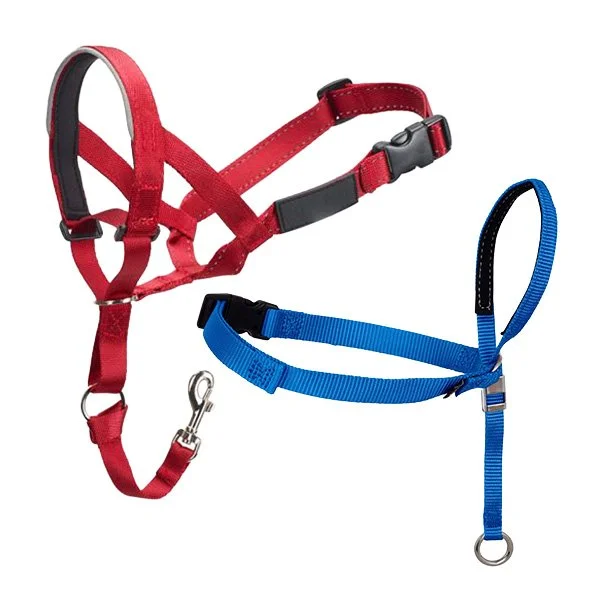
Photo shows a couple examples of head collars. (Red) A Halti style that has the extra nose straps and the safety strap with leash ring. (Blue) A Gentle Leader with one nose strap and a leash ring.
Head Collars:
Head collars are designed with a neck strap that fits like a collar at the highest part of the neck. Then there is a strap that goes around the snout, called the nose loop, with a leash ring attached below it. The leash then clips to the leash ring and when the dog pulls, the nose loop puts pressure onto the snout and turns the dog’s head back toward the handler. These work very similarly to a bridal on a horse.
There are two main styles of head collars, the Halti style and the Gentle Leader style. The Halti style has the neck strap, additional stabilizing straps that attach the nose and neck straps together, a leash ring below the nose loop and a safety strap that comes down from the leash ring with a clip at the end that connects to the dog’s flat collar in case the head collar breaks or comes off. The Gentle Leader style is more simple with just the neck strap, adjustable nose loop and the leash ring that hangs below the nose loop. This style does not have a built-in safety strap but a separate safety safety strap can be used with it and function the same way as the Halti.
Time needs to be spent for the dog to work with the head collar and learn that the pressure is coming from what the dog is doing and they can learn to self-correct. It is recommended to work with a training professional when introducing any training tool to ensure proper use and safety so the collar can work as intended and produce positive results. The dog needs to be allowed time to not only learn to use the collar but get used to having something on its face in general.
Head collars should NEVER be used on dogs that are known to lunge! It is very easy for a lunging dog to be severely injured in the snout or the neck when their head is unexpectedly wrenched to the side with force. Head collars are ONLY appropriate for dogs that are gradual pullers. Usually these are dogs with naturally quicker walking speeds than their handlers or dogs that seek pressure on the leash and gradually continue to add pressure as they walk.
Head collars must NEVER be used on a tie-out! They can easily cause sever injury when the pressure is not being controlled with a handheld leash. Hard or quick pulling can cause severe injuries and even lead to death. A dog should also never be left unsupervised while wearing a head collar as it can get caught and become a serious safety and injury risk.
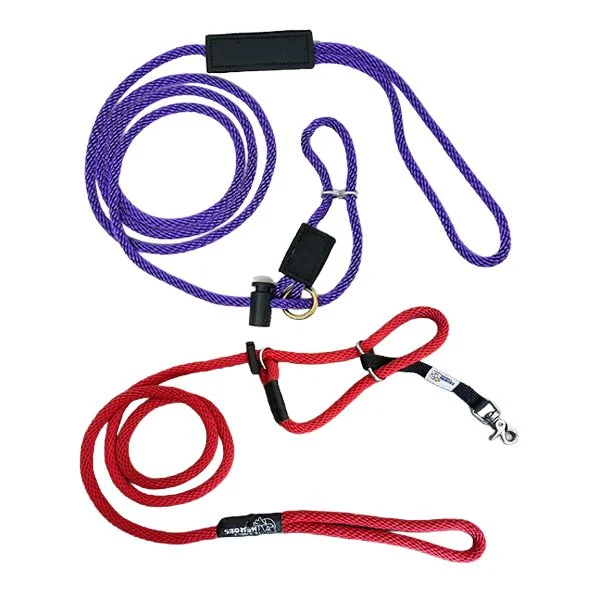
Photo shows a couple examples of transitional leashes. (Purple) An example of a transitional head collar leash that does not have a safety strap. (Red) Heather’s Heroes brand Sidekick leash that features the built in safety strap.
Transitional Leashes:
Transitional leashes are part collar and part leash. The focus of this section is on how they act as a head collar. This leash is one continuous line that has part of it looped around the dog’s snout, then the rest of the loop comes around to the back of the head where the leash portion extends from. They have a sliding stopper bead that keeps the line from slacking and coming off. Some models, like the Heather’s Heroes Sidekick, will have a safety strap that clips to the dog’s collar. If there is some kind of failure and the head collar part comes off, the dog is still attached to the leash.
They are designed to use pressure on the bridge of the nose like a head collar but instead of the leash being attached under the snout and pulling the dog’s head around to the side, the leash part comes from the back of the head and pulls the entire head back with downward pressure on the nose.
This style is a bit safer for dogs that pull hard or can lunge because the head is not being pulled sideways, it’s more of a backward type of pressure. Still, proper training with any tool is key to making sure it is being used safely and humanely. If the dog continues to pull on this design even with training, CCO recommends trying a different tool to avoid nasal and neck injuries.
Transitional leashes must NEVER be used on a tie-out! They can easily cause sever injury when the pressure is not being controlled with a handheld leash. Hard or quick pulling can cause severe injuries and even lead to death. A dog should also never be left unsupervised while wearing a transitional leash as it can get caught and become a serious safety and injury risk.
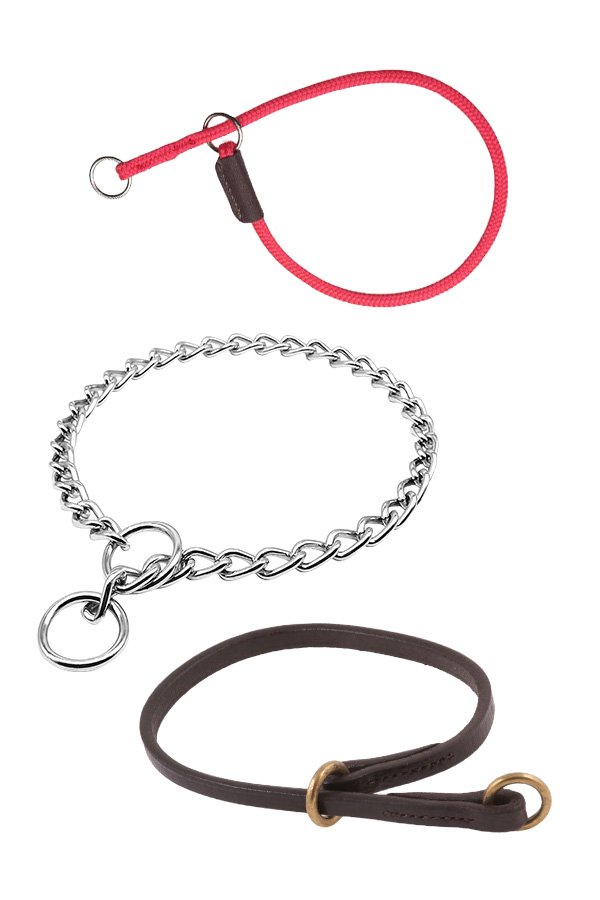
Photo shows a few examples of slip collars. (Top) A “braided” slip collar that is more of a thinner rope material. (Middle) A chain slip collar. (Bottom) A leather slip collar.
Slip Collars:
Slip collars are designed to use pressure around the neck to reduce pulling. They are made with two rings and some kind of line in between them that is formed into a loop. The ring that does not have the line running through it is the ring that the leash attaches to. When the dog pulls, the loop tightens and the pressure is meant to discourage the dog from pulling. A slip collar can also be an excellent backup safety line for a different collar. The leash is attached to both collars and if the other collar breaks or comes undone, the slip collar is there to keep the dog contained and still on leash.
Slip collars can be made out of several different materials like a “braided” rope type of line, leather, BioThane or neoprene, nylon and chain. Each material type has pros and cons so understanding how it will be used is what should determine which kind to get. Some may be stronger, more sanitary, lighter weight, more hypoallergenic, or more aesthetically versatile than others.
Time needs to be spent for proper sensitization with the slip collar so the dog learns that the pressure is coming from what the dog is doing and they can learn to self-correct. There should never be prolonged or continuous pressure on the collar, proper use is a quick pressure and release movement. It is recommended to work with a training professional when introducing any training tool to ensure proper use and safety so the collar can work as intended and produce positive results.
Slip collars must NEVER be used on a tie-out! They can easily cause sever injury or death when the pressure is not being controlled with a handheld leash. A dog should also never be left unsupervised while wearing a slip collar as it can get caught and cause the dog to panic and continue pulling which quickly becomes a strangulation risk. Slip collars do not usually have a mechanism to stop the cinching action and they can tighten indefinitely. This can easily lead to severe neck injuries like a crushed esophagus, blood circulation being interrupted and causing brain damage, strangulation leading to death, etc.
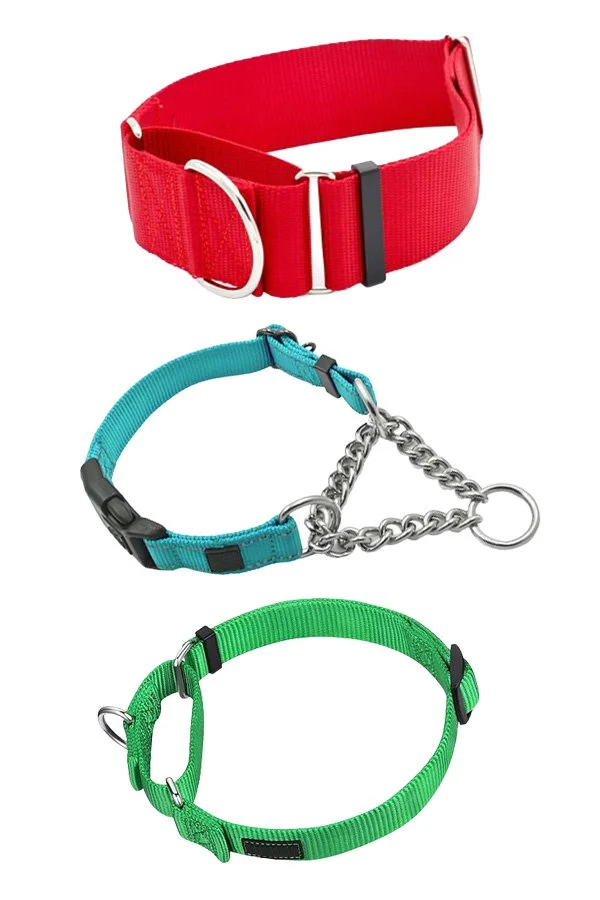
Photo shows a few examples of martingale collars. (Top) A wide martingale for larger dogs and dogs with more delicate necks. (Middle) A martingale with a plastic buckle and a chain cinch loop. (Bottom) A standard slip-over martingale collar.
Martingale Collars:
Martingale collars are designed similarly to a standard flat collar except they have what is called a cinch loop. The leash attaches to the ring on the cinch loop which allows the collar to tighten when pressure is applied to the leash. Some martingales are made with a wider straps which allow the pressure to be distributed over a wider area so that it’s safer for larger dogs like great danes and dogs with longer or more delicate necks like greyhounds. Standard martingales are designed to slip over the dog’s head and then be worn around the neck. Since the head is usually wider than the neck, they need to be tightened once they are put on in order to make sure the cinch loop works correctly. If it is left loose, the dog could manage to slip out of it and the pressure will not work the way it’s meant to. Some martingales are made wtih buckles which allow the collar to be put on without having to keep making adjsutments.
Martingales can be made with different kinds of materials like nylon, leather and BioThane or neoprene. Some also have a chain or braided rope type cinch loop.
Time needs to be spent for proper sensitization with the slip collar so the dog learns that the pressure is coming from what the dog is doing and they can learn to self-correct. There should never be prolonged or continuous pressure on the collar, proper use is a quick pressure and release movement. It is recommended to work with a training professional when introducing any training tool to ensure proper use and safety so the collar can work as intended and produce positive results.
Time needs to be spent for the dog to work with the martingale collar and learn that the pressure is coming from what the dog is doing and they can learn to self-correct. It is recommended to work with a training professional when introducing any training tool to ensure proper use and safety so the collar can work as intended and produce positive results.
Martingale collars must NEVER be used on a tie-out! They can easily cause injury when the pressure is not being controlled with a handheld leash. Martingale collars are safe enough to be left on without supervision but should’t be attached to anything. Though they have a cinch loop that doesn’t allow the collar to tighten all the way, the added pressure in the collar can still stop the dog from being able to breath properly, interrupt blood-flow to the brain and cause other serious injuries or death.
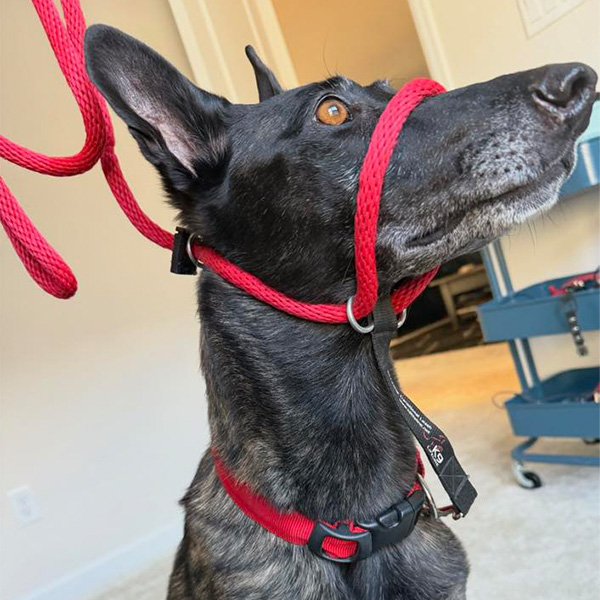
Photo shows a side view of the Heather’s Heroes Sidekick transitional leash. The larger loop is sectioned in two by the S-ring, the furthest part of the loop is around the dog’s snout and the other part of the loop is around the dog’s neck and extends into the leash portion and held in place by the stopper bead. The loops are snug to the face but not tight. The safety strap extends from the S-ring and clips to the D-ring on the dog’s flat collar.
(Photo submitted by Sam Ward)
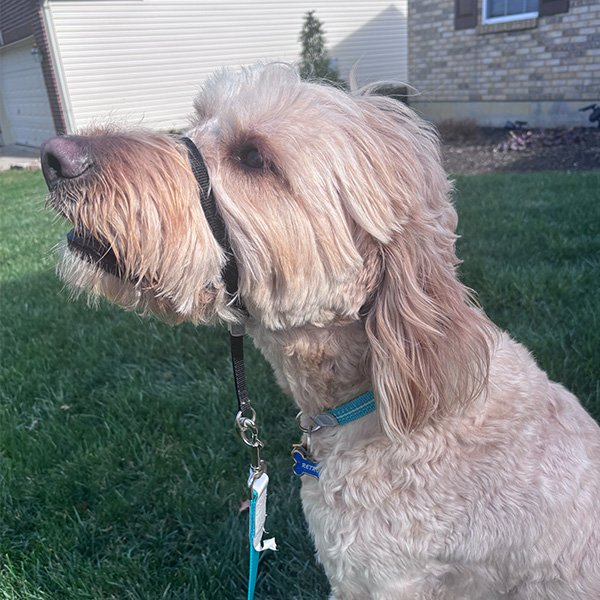
Photo shows a side view of a Gentle Leader head collar. The neck strap fits like a collar high on the dog’s neck and the nose loop is snug around the snout but not tight. The adjustment clip under the nose loop is adjusted to hold it in place and the leash is clipped to the leash ring handing under the chin.
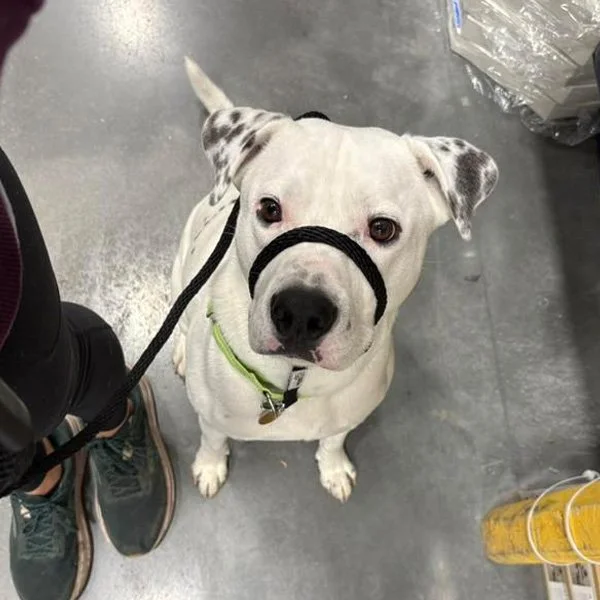
Photo shows a front view of the Heather’s Heroes Sidekick transitional leash. The nose loop is snug around the snout but not tight. The leash portion extends from the back of the head where it is held in place by the stopper bead. The safety strap can be seen hanging down and is clipped to the dog’s flat collar.
(Photo submitted by Sammy Hellums)
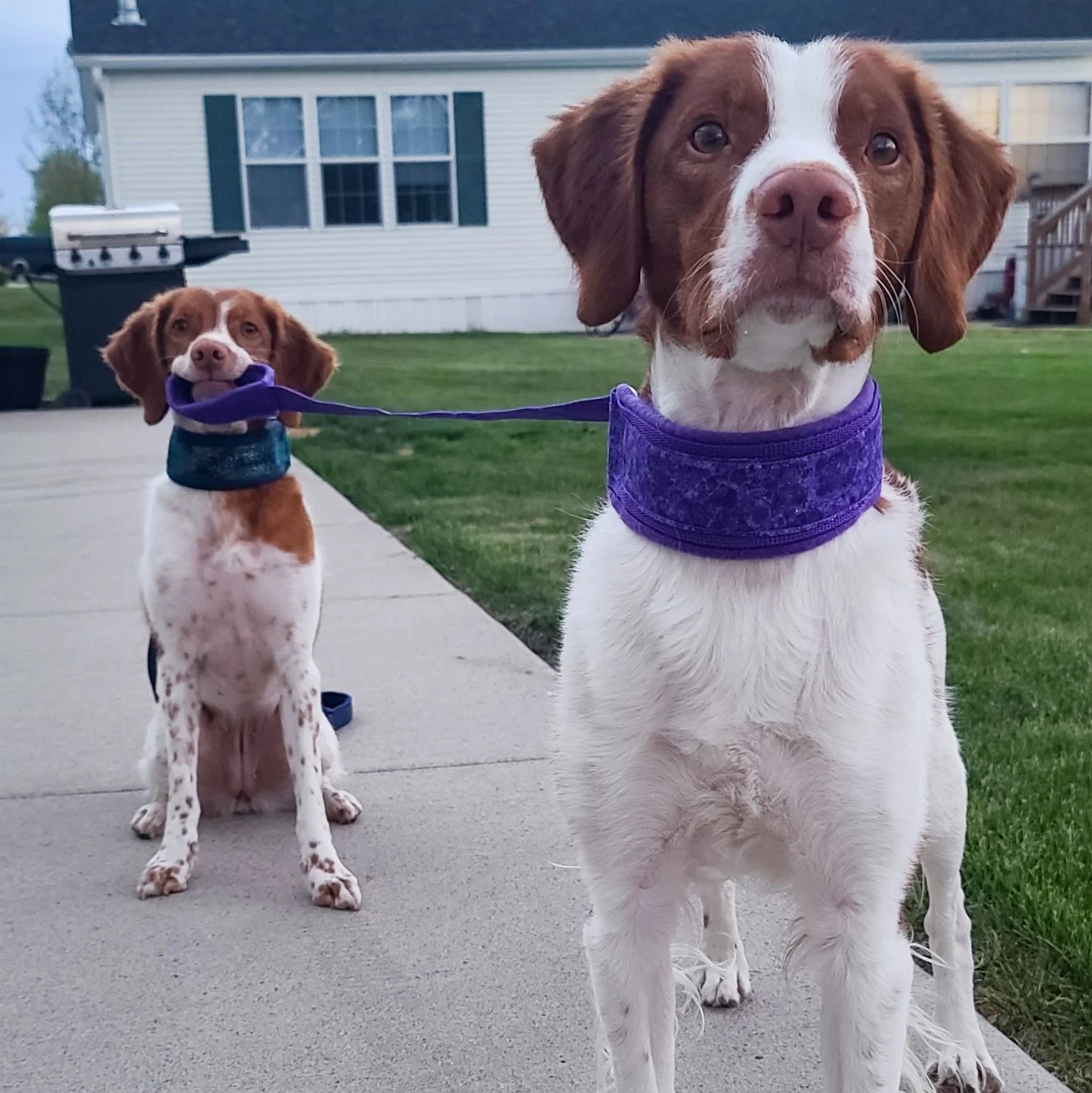
Photo shows two dogs, both wearing wide martingale collars that distribute pressure over a larger space and makes them more comfortable to wear.
(Photo submitted by Jenna Hardy)
*Custom Canine Obedience is not affiliated with, endorsed by, or sponsored by any of the companies, brands or organizations mentioned or linked on this page. Any references or links provided are for informational and convenience purposes only. We may recommend certain products or services based on our professional experience and opinion; however, these recommendations are independent and reflect what we believe may be beneficial for dog owners and their pets. We do not guarantee the performance, quality or suitability of any third-party products or services. We encourage you to research all products thoroughly and choose what best fits your individual dog’s needs under professional guidance.